The organisation: a small coordination team, many volunteers
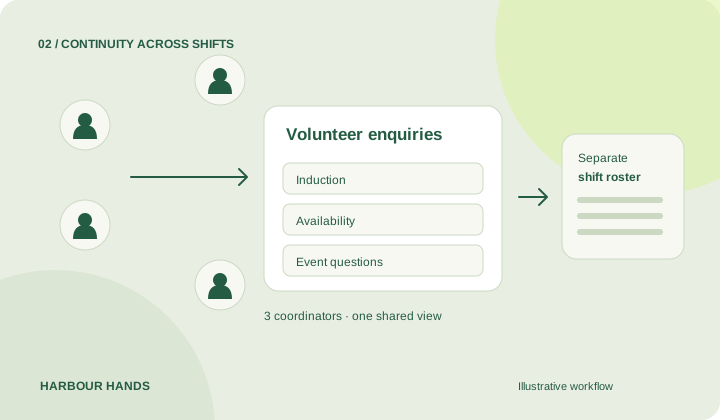
Harbour Hands is a fictional not-for-profit organising neighbourhood food deliveries and community events. It has a network of 60 volunteers, supported by three staff coordinators. New volunteer enquiries, availability changes, and event questions arrived by email. The coordinators worked across different days, so an enquiry often outlasted the shift of the person who first read it.
The challenge: keeping a promise across shifts
A volunteer might ask about an induction session, receive an initial answer, and then reply to someone who was off duty. Information about the next action was buried in forwarded email chains. The group needed a dependable place for coordinators to handle correspondence. It did not need all 60 volunteers to become software users, and it already maintained a separate roster for event assignments.
The choice: three Growth seats, not sixty volunteer seats
Harbour Hands chose Growth for its three staff coordinators at the standard monthly rate of $49 per agent: $147 per month before tax. Volunteers remained external email contacts and did not receive workspace access, so they did not use paid seats. Every person given active RelayDesk workspace access would count as a paid agent. This scenario assumes standard pricing; RelayDesk does not publish a not-for-profit discount.
The setup: separate the queue from the roster
The coordinators created volunteer and event inboxes, plus tags for induction, availability, and event questions. They kept shift scheduling, attendance, consent records, and background checks in their existing systems. Saved replies explained where volunteers could find induction information and how to report an availability change. Each coordinator reviewed the reply before sending it rather than relying on automated responses.
The daily process: make the next action explicit
Growth’s round-robin routing distributed new enquiries among coordinators. Business-hours conditions reflected the coordination office’s working pattern. A coordinator used a private note to record a handoff and set a conversation to Pending when waiting for a volunteer’s response. If a volunteer changed an event commitment, the coordinator updated the separate roster manually and replied through RelayDesk. An inbox status was never treated as a confirmed shift assignment.
The boundaries: volunteers are contacts, not free viewers
Only the three coordinators could open the workspace. Volunteers received public email replies; they could not see private notes or other volunteers’ conversations. RelayDesk was not a volunteer portal, a scheduling tool, or a background-check service. The team avoided collecting medical information, identity documents, or detailed safeguarding reports in the inbox, using its established restricted process for those matters.
The outcome: continuity without adding a new job for volunteers
In this fictional scenario, a coordinator starting a shift could read the conversation, see its owner, and understand the outstanding action. Volunteers could continue using email, while the staff team gained a shared view of follow-ups. Growth’s workload and SLA reports helped the team review its own business-hours response targets. No numerical impact, compliance assurance, or real customer endorsement is claimed.