The team: three people wearing several hats
Fieldnote is a fictional startup building inventory planning software for independent retailers. Its founder, a customer success lead, and a product specialist all answer customer emails alongside their other work. As the first wave of onboarding questions arrived, a single support address forwarded messages to all three personal inboxes. Everyone could see a question, but nobody could reliably tell who was handling it.
The challenge: helpful people, scattered context
A retailer asking about a CSV upload might receive two different replies. Another customer might wait because each teammate assumed someone else had responded. Answers to recurring questions lived in sent folders, and a product specialist returning from a day of development had to ask the founder for context. The team needed a simple way to share responsibility without turning customer support into a separate department.
The choice: Starter, with three paid seats
Fieldnote chose RelayDesk Starter on monthly billing. Three active agents cost $72 per month before tax at $24 per agent, including the founder’s seat. Starter’s shared inbox, private notes, saved replies, tags, and simple assignment rules covered the immediate need. The team did not need Shopify, round-robin routing, or SLA reporting, so it had no reason to move to Growth.
The rollout: make ownership visible first
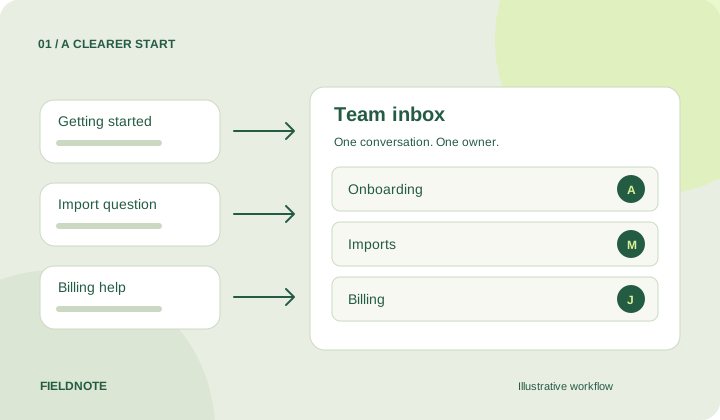
The customer success lead created a shared support inbox and tested email forwarding with the other two teammates. They agreed to use Open for work requiring attention, Pending when waiting on a customer, and Resolved when the question was answered. Each open conversation received one owner. Tags identified onboarding, imports, and billing questions; private notes captured what had already been checked without sending internal discussion to the customer.
The everyday workflow: fewer handoffs from memory
The team created editable saved replies for common setup questions, then used two of Starter’s five available simple assignment rules to route tagged conversations to an agent. Rules applied to new conversations rather than reorganising historical messages. When an onboarding question became a product issue, the current owner added a private note and reassigned it to the product specialist. Collision detection warned teammates when another person was already drafting a reply.
The outcome: a calmer way to stay accountable
In this fictional scenario, the useful change was that the team could open one queue and see the next action. The founder no longer had to act as the memory of every customer exchange, and the customer success lead could follow up on pending conversations without asking who had replied. These are illustrative workflow outcomes, not measured customer results; no response-time reduction or revenue improvement is claimed.
What another startup can take from this
Start with ownership, a few meaningful tags, and answers that agents can adapt. Fieldnote reviewed conversation volume and workload in Starter’s standard reports, with 90 days of reporting history. It would consider Growth if round-robin routing or SLA reporting became necessary. RelayDesk did not replace its product backlog, write replies automatically, or eliminate the need for a person to decide what a customer needed.